


The right SKU strategy for jewelry combines three things: a centralized master data file, a parent-child variant model, and stable, machine-readable naming that never encodes price, season, or vendor codes. Start by building that master file, locking your naming rules, and setting inventory targets by SKU class. Get those three pillars right before you touch a platform like Jewelcloud, and everything downstream, from fulfillment to reordering, gets easier.
TL;DR:
- Use a consistent four-segment SKU structure without encoding price, season, or vendor information to ensure stability at scale.
- Maintain a centralized master file with crucial fields like SKU, parent ID, cost, retail price, vendor reference, lead time, and safety stock.
- Reconcile channel sales data monthly to prevent ghost inventory caused by mismatched or inconsistent SKU formats and capitalization.
- Implement parent-child SKU architecture to track designs and variants effectively, accommodating Shopify’s three-variant limit and using workarounds.
- Treat seasonal and trend SKUs with different inventory rules, using forward-weeks-of-supply and setting clear retirement dates for better demand management and reporting.
Table of Contents
- Why Jewelry SKU Strategy Works Differently Than Other Retail
- Building a Centralized Inventory Master That Actually Holds Up
- How Should You Name Jewelry SKUs So They Scale?
- Parent-Child SKU Architecture and Working Around Shopify’s Limits
- Why Does Channel Sync Keep Creating Phantom Inventory?
- Fulfillment and Warehouse Practices That Cut Picking Errors
- What Inventory Formulas Should Guide Your Buy Budget?
- Turning SKU Data Into a Feedback Loop
- How JewelCloud Supports SKU Master Data at Scale
- Pricing and Discounting Need to Follow Your SKU Structure, Not Fight It
- Material and Hallmarking Differences Deserve Their Own SKU Segment
- Seasonal and Trend SKUs Need Different Rules Than Core Stock
- Your First 90 Days: A Jewelry SKU Rollout Checklist
- Ready to Simplify Your SKU and Catalog Management?
- Sources
Why Jewelry SKU Strategy Works Differently Than Other Retail
A single ring style isn’t one SKU. It’s a size, a metal color, a stone option, and sometimes an engraving variant, all stacked on top of each other. A retailer carrying 20 core designs can easily generate 400 to 600 SKUs once you multiply out sizes and metals, and each of those variants might sell only a handful of units per year at a price point that makes every miscount expensive.
That combination, high variant count paired with low unit velocity and high average order value, is what makes generic retail inventory advice fall short for jewelers. The failure modes are predictable:
- SKUs get reused for new designs after old ones are discontinued, corrupting historical sales data.
- Dynamic information like price or season gets baked into the SKU itself, so a markdown breaks the identifier.
- The same product carries different SKUs across your POS, your Shopify store, and your wholesale sheet.
New brands often overbuild the catalog before they understand what sells. A focused launch catalog of 12 to 18 core styles, expanding to roughly two dozen SKUs once you add simple variants, gives you enough range to test demand without drowning in inventory you can’t turn.
Building a Centralized Inventory Master That Actually Holds Up
Most jewelry SKU chaos traces back to one root cause: no single source of truth. A spreadsheet or an inventory management system (IMS) fixes that, but only if it’s structured correctly from day one.
Your master file needs these columns, and each earns its place:
- SKU — the permanent identifier, never reused.
- Parent ID — links variants back to the core design.
- Cost and retail price — kept separate from the SKU string itself.
- Vendor reference — your supplier’s own part number, mapped but not merged into your SKU.
- Lead time — critical for reorder timing.
- Safety stock level — set by SKU class, not guessed.
Operationally, tie every incoming shipment to a purchase order before it hits the floor, and run a monthly CSV audit comparing your master file against what’s actually in stock by following comic book store inventory best practices. That single habit catches duplicate SKUs and blank fields before they cause a stockout or an oversell.
Pro Tip: Move from a spreadsheet to a dedicated IMS or product-data platform the moment you’re managing more than 300 to 500 active SKUs across two or more sales channels. Below that threshold, a well-maintained spreadsheet with locked columns and a monthly audit routine works fine.
How Should You Name Jewelry SKUs So They Scale?
A SKU is not a description. It’s a permanent, machine-readable identifier, and the moment you treat it as anything else, you set yourself up for a renumbering project down the road.
The pattern that holds up at scale follows a four-segment structure: Category, Product ID, and one or two variant attributes, all in uppercase with hyphens separating each segment and numbers zero-padded to a consistent length. A four-segment SKU formula like RNG-00042-G18-SZ7 tells you at a glance: ring, product 42, 18-karat gold, size 7, without a single lookup.
What you should never encode:
- Current price (it changes; your SKU shouldn’t).
- Season or year (a “spring 2026” tag makes a timeless design look expired).
- Vendor codes (your supplier’s part number belongs in its own field, not fused into yours).
Shopify’s own guidance recommends SKU length between 10 and 20 characters, which is enough room for a category, ID, and two variant flags without becoming unreadable. Run a quarterly audit for SKUs with inconsistent capitalization, missing hyphens, or values shorter than your standard. A SKU audit that catches five bad entries today saves you a reconciliation nightmare in twelve months, and it’s far cheaper than a full renumbering pass.
Parent-Child SKU Architecture and Working Around Shopify’s Limits
A parent SKU represents the design itself; child SKUs represent each purchasable variant, size 6 in yellow gold, size 7 in white gold, and so on. This structure is the operational backbone for jewelry brands, because it lets you report sell-through at the design level while still tracking exact stock per variant.
The benefit shows up fastest in replenishment. If a design sells well but one size consistently lags, parent-child reporting tells you that immediately instead of burying the signal inside 15 flat, unrelated SKUs.
Shopify caps variant options at three per product, which trips up jewelers who want size, metal, and stone all as separate selectable attributes. Common workarounds include:
- Splitting listings by the primary attribute (metal color) and using size and stone as the remaining two variant options.
- Using metafields to carry extra attributes like gemstone origin or hallmark without consuming a variant slot.
- Adding a variant management app when a collection genuinely needs four or more attribute dimensions.
Whatever workaround you choose, keep your master file as the single source of truth. Channel-specific listings can look different, but the underlying SKU and parent link should stay identical everywhere.
Why Does Channel Sync Keep Creating Phantom Inventory?
Sync failures almost never come from a system bug. They come from a SKU that reads RNG-00042-G18 in your POS and RNG-00042-G18 (with a trailing space) in your e-commerce platform. Case mismatches, stray hyphens, and blank SKU fields all break exact-match syncing, and the result is either an oversell or a “ghost” unit that shows available online when it already sold in-store.
Run this monthly:
- Export your master file, your storefront channel, and your 3PL feed as CSVs.
- Compare all three for mismatches, duplicates, or differing quantities.
- Flag and correct any discrepancy within 24 hours, before the next order cycle.
- For a channel with repeated phantom inventory, lock new listings on that channel until you’ve fully reconciled it against the master file.
This routine is tedious. It’s also the single highest-leverage control you can run, because a $4,000 ring oversold to two customers costs far more than the ten minutes the audit takes.
Fulfillment and Warehouse Practices That Cut Picking Errors
Small, expensive, and visually similar items demand a different warehouse approach than bulky retail goods. Bin-tag every SKU individually rather than by product family, and serialize high-value pieces so each unit, not just each SKU, has a traceable identity.
For picking, batch your fastest-moving core SKUs together so a single pass through the bins fills multiple orders at once, and reserve individual picking for signature or made-to-order pieces where mistakes are costliest.
- Bin-tag by exact SKU, not by style name.
- Serialize pieces above your internal value threshold.
- Batch-pick core replenishment SKUs; individually pick signature items.
- If you use a 3PL, confirm their labeling standard matches your SKU format exactly, especially for drop-ship handoffs where a mismatch never gets caught until the customer complains.
Pro Tip: Give your 3PL a locked copy of your master SKU file, not a live spreadsheet link. A 3PL working from stale data is a common, invisible cause of fulfillment errors.
What Inventory Formulas Should Guide Your Buy Budget?
Open-to-buy (OTB) converts your sales plan into a dollar figure you’re allowed to spend on new inventory. The compact version: take planned sales for the period, add your target ending inventory, subtract inventory already on hand, and subtract anything already on order. What’s left is what you can spend.
Days-of-inventory targets should vary by SKU class, not sit on one blended number. Industry benchmarks put core replenishable styles at 90 to 120 days of inventory and signature or high-ticket pieces at 120 to 180 days, with turns landing in the 2 to 4x range annually.
| SKU class | Days-of-inventory target | Typical turns/year |
|---|---|---|
| Core replenishment | 90 to 120 days | 3 to 4x |
| Signature/high-ticket | 120 to 180 days | 2 to 3x |
| Seasonal/trend drops | Weeks-of-supply model | Varies by drop |
Safety stock should be calculated, not eyeballed. The standard formula, Safety Stock = Z × sigma_D × sqrt(L), where Z is your target service level, sigma_D is demand variability, and L is lead time, translates in practice to roughly 1 to 2 times lead-time demand for core SKUs and 2 to 3 times for signature or long-lead pieces. Every extra buffer unit on a $3,000 piece is real cash sitting in a case, so size that buffer to your actual service-level target, not your comfort level.
Plan core replenishment on weeks-of-supply; plan seasonal drops on forward-weeks-of-supply, since a trend piece’s demand curve looks nothing like a wedding band’s steady pull.
Turning SKU Data Into a Feedback Loop
Five numbers matter more than the rest: sell-through rate, turns, days-of-inventory, supplier lead time, and margin by SKU. Track them monthly, not quarterly, because jewelry demand shifts faster than a quarterly review can catch.
- Review sell-through by SKU class every month, not just at season close.
- Retire a SKU once it’s shown weak sell-through for two consecutive review cycles with no clear seasonal explanation.
- Expand the catalog when a hero SKU shows strong sell-through, repeat customer requests pile up, or add-to-cart rates run high against weak conversion, all signals that demand exists beyond what you’re currently stocking.
- Feed every naming or sync error the audit catches back into your governance rules immediately, not at the next planning cycle.
How JewelCloud Supports SKU Master Data at Scale
Structured, standardized product data is the difference between a collection launch that takes days and one that takes weeks of manual cleanup. When supplier catalogs land in inconsistent formats, every retailer downstream inherits that inconsistency as sync errors and mismatched listings.
- Supplier catalog ingestion that normalizes vendor data into a consistent structure before it ever reaches a retailer’s site.
- Master-data standardization that keeps parent-child relationships and variant attributes intact across every channel.
- Syndication tools that push normalized catalogs to retail partners without manual re-entry, cutting the errors that come from copying data by hand.
Retailers building out assortments can pair this approach with a broader catalog management strategy to keep SKU governance consistent as the range grows.
Pricing and Discounting Need to Follow Your SKU Structure, Not Fight It
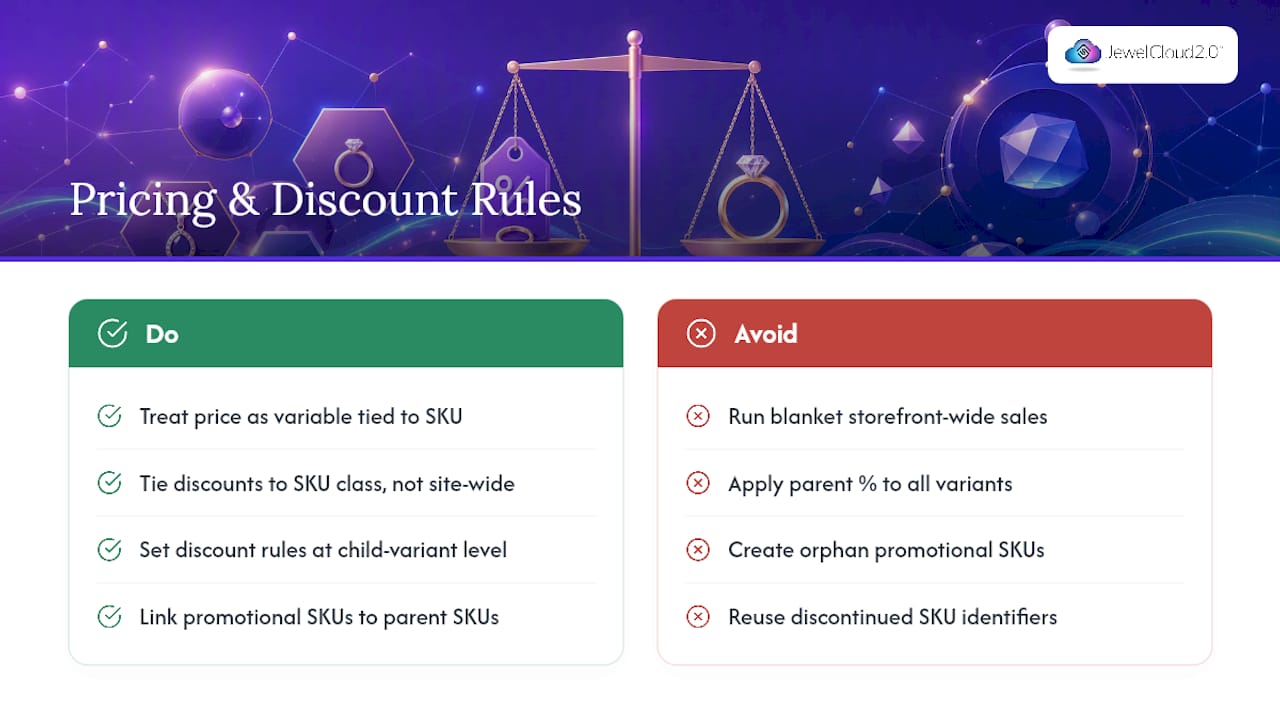
A SKU strategy that never encodes price only works if your pricing and discounting systems respect that separation. Once your master file treats price as a variable field tied to a stable SKU, you gain the flexibility to run promotions without ever touching the identifier itself, and that flexibility is worth building deliberately.
Tie your discount logic to SKU class rather than blanket storefront-wide sales. Core replenishment pieces, wedding bands, simple studs, and chain styles you expect to reorder for years, should rarely see deep markdowns, since aggressive discounting on a SKU you plan to keep in the line indefinitely trains customers to wait for the next sale. Signature and seasonal SKUs are the better candidates for markdown cycles, because once that inventory clears, the SKU itself may retire.
Metal and stone variants complicate this further. A ring’s silver variant and its 18-karat gold variant share a parent SKU but carry very different cost structures, so a single percentage discount applied at the parent level can quietly erase your margin on the higher-cost child SKU while barely denting margin on the cheaper one. Set discount rules at the child SKU level, tied to that variant’s actual cost, not the parent’s average.
Bundle and multi-buy promotions need the same discipline. If you bundle a necklace and earring set under a promotional SKU, that promotional identifier should reference back to the two parent SKUs in your master file rather than existing as an orphaned entry with no lineage. Otherwise your sell-through reporting on the individual pieces goes blank the moment the bundle sells, and you lose the exact signal you need to decide whether to keep either piece in the line.
Clearance pricing on discontinued SKUs deserves its own rule: mark the SKU inactive in your master file the day it’s fully sold through, and never assign that identifier to a new design, no matter how tempting the tidy numbering looks.
Material and Hallmarking Differences Deserve Their Own SKU Segment
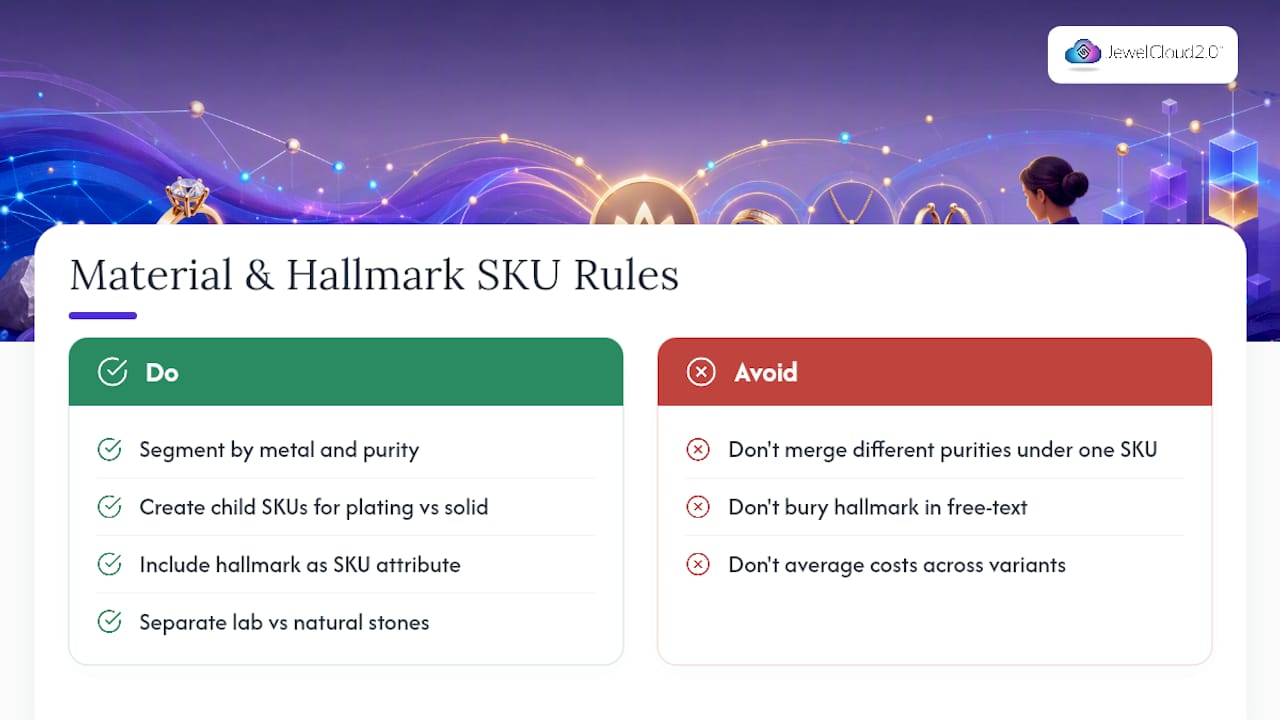
Two rings can look identical in a product photo and still be entirely different inventory items once you account for metal purity, plating, and hallmarking. A 14-karat gold band and an 18-karat version of the same design carry different costs, different melt values, and often different hallmark stamps required by law depending on where the piece is sold. Treating them as “the same SKU with a note” is how cost accounting quietly falls apart.
Your variant segment should capture metal type and purity explicitly, gold karat, sterling silver, platinum, and plating type where relevant, because these differences drive cost basis, not just customer preference. A gold-filled piece and a solid-gold piece in the same design family need to sit as distinct child SKUs under the same parent, never merged, since their margins and even their return-and-repair handling differ.
Hallmarking adds another layer for brands selling internationally or through wholesale channels that require compliance stamps. If a supplier ships you both hallmarked and non-hallmarked versions of a design, that distinction has to live in the SKU or a tightly linked attribute field, not buried in a free-text note that a warehouse picker will never see. A mispick here isn’t just an inventory error, it can be a compliance problem depending on your market.
Lab-grown versus natural stone variants follow the same logic. The cost gap between a lab-grown diamond and a natural stone of comparable size can be substantial, and customers increasingly ask specifically for one or the other. Give each its own child SKU rather than a shared listing with a dropdown note, because your reorder and margin data will be wrong the moment those two cost structures get averaged together in your reporting.
Seasonal and Trend SKUs Need Different Rules Than Core Stock
Trend-driven jewelry, holiday collections, color-of-the-year gemstone pieces, capsule collaborations do not behave like a wedding band that sells steadily for a decade. Treating a seasonal SKU with the same reorder logic as a core style is one of the most common planning mistakes jewelers make.
Plan seasonal drops on forward-weeks-of-supply rather than the days-of-inventory targets you’d use for core replenishment. That means projecting demand for the specific window the piece will sell, often 8 to 12 weeks around a holiday or trend peak, rather than assuming steady year-round velocity.
Naming still matters here, arguably more. It’s tempting to bake “HOL2026” or “VDAY” into a seasonal SKU for quick identification, but that’s exactly the trap the naming rules exist to prevent. A seasonal SKU still needs to be permanent and machine-readable; use your parent ID and variant segments to indicate the collection through a linked attribute field, not through the SKU string itself. If the design gets brought back next year with a slight update, you want the option to reuse the parent lineage without a naming collision.
Set a hard retirement date for trend SKUs before the season even launches, and build that date into your master file as a flag, not a mental note. When the window closes, mark remaining units for clearance immediately rather than letting them linger at full price into the next quarter, where they’ll quietly drag down your overall sell-through metrics and confuse your reorder signals for core stock.
Your First 90 Days: A Jewelry SKU Rollout Checklist
Weeks 1 to 4: build your master SKU file, lock naming rules, and run your first full audit. Weeks 5 to 8: pilot an IMS if you’ve outgrown spreadsheets, and map every channel to the master file. Weeks 9 to 12: full rollout, second audit, and a written governance rule: never reuse a retired SKU, and log every naming change in one place.
— Anthony
Ready to Simplify Your SKU and Catalog Management?
If everything above sounds like a lot of manual upkeep, that’s because it is, unless your product data is structured before it ever reaches your systems. Some platforms exist specifically for this problem: to standardize supplier catalogs into consistent, machine-readable product data, so the naming, variant, and sync issues covered here get resolved at the source instead of during your monthly audit.

For retailers, that means faster collection launches using real vendor data instead of manually rebuilt spreadsheets. For suppliers and vendors, it means your catalog reaches qualified retail partners already formatted to their systems, cutting the back-and-forth that usually stalls a new listing. Explore the vendor benefits Jewelcloud offers, or visit the platform overview to see how structured syndication fits into your current SKU strategy.
Sources
- Jewelry Brand Inventory Planning: The Cash Trap Guide | Eightx
- Shopify SKU system guide: naming conventions that scale past 10,000 products - Craftshift