


Structured product data in jewelry wholesale is the standardized framework of attributes, relationships, and digital assets that makes every product in your catalog findable, accurate, and ready to sell. The industry term for this practice is Product Information Management, or PIM. Jewelers who implement PIM systems report online sales increases up to 25% and cut new merchandise onboarding from weeks to days. That kind of result does not happen by accident. It comes from building a data foundation where every SKU carries complete, consistent, and channel-ready information from the moment it enters your system.
What is structured product data in jewelry wholesale?
Structured product data is a defined set of fields, each with a fixed format, that describes every item in your wholesale jewelry catalog. Think of it as a product profile: metal type, gemstone details, carat weight, certification number, finish, dimensions, and price. Without that profile, your catalog is just a list of names and photos. With it, your catalog becomes a decision engine that shoppers, search engines, and retail partners can all use efficiently.
The role of product data in jewelry retail goes beyond simple listing management. Rich product metadata improves SEO rankings and helps shoppers make confident comparisons, which directly raises conversion rates. A product page that tells a shopper the ring is 14K yellow gold, size 6, set with a 0.75ct VS1 round diamond, and GIA certified gives them everything they need to buy. A page that says “diamond ring” does not.
What are the essential attributes for wholesale jewelry product data?
Every wholesale jewelry listing needs a core set of attributes to function across channels. These fields cover the product itself, its variants, and its certifications.
Core attributes every jewelry SKU needs:
- SKU and parent SKU for variant grouping
- Metal type and karat (e.g., 14K white gold, sterling silver)
- Gemstone type, shape, and quality grades (cut, color, clarity, carat)
- Certification body and certificate number (GIA, AGS, IGI)
- Finish and surface treatment (polished, matte, rhodium plated)
- Dimensions and weight (length, width, depth, gram weight)
- Product category and subcategory (rings, bridal, fashion, earrings, pendants)
- High-resolution image URLs and video asset links
One attribute structure that wholesale jewelers frequently underestimate is the parent-child relationship. A single ring style can carry 40+ variations across size, metal, and stone combinations. Flat spreadsheets collapse under that complexity. A parent-child model groups shared design attributes at the parent level and pushes unique variants to child records, keeping your catalog clean and your inventory counts accurate.
| Attribute type | Example values | Why it matters |
|---|---|---|
| Metal and karat | 14K yellow gold, platinum | Drives faceted filters and price calculation |
| Gemstone quality | GIA D/VS1, 1.02ct round | Supports evidence-based pricing and buyer trust |
| Product category | Bridal, fashion rings, pendants | Enables catalog segmentation and channel mapping |
| Certification | GIA #2195769302 | Reduces returns and builds shopper confidence |
| Variant structure | Parent SKU + child SKU per size | Required for accurate inventory tracking |
Pro Tip: Build your attribute dictionary before you load a single product. Define every field name, accepted values, and format rules in a shared document. This prevents inconsistent entries like “14k” vs. “14K” vs. “14 karat” from fragmenting your search results.
Which systems support jewelry product data management?
Three system categories form the backbone of any serious wholesale jewelry data operation: PIM, DAM, and ERP integration.
A Product Information Management (PIM) system centralizes all product attributes in one place and pushes updates to every connected channel simultaneously. Catalog automation through a PIM means one spec change flows predictably across your website, wholesale portal, and marketplace listings without manual re-entry. That consistency is the difference between a catalog that builds trust and one that creates confusion.
A Digital Asset Management (DAM) system handles your images, videos, and 360-degree spin files. Enterprise jewelry retailers manage over 100,000 assets and 12,000 unique product SKUs, which is impossible to manage through shared drives or email threads. Leading operations use a single master asset URL across all marketing channels. That approach prevents broken image links and cuts the time needed to launch new campaigns.

ERP integration is the piece most wholesalers underestimate until it fails. Jewelry websites without ERP integration develop data silos that cause system instability, and shallow integrations commonly fail within six months of launch. Real-time pricing feeds tied to commodity markets for gold and platinum are not optional. Manual price updates expose your margins to real risk in volatile precious metal markets.
| System category | Primary function | Jewelry-specific requirement |
|---|---|---|
| PIM | Centralizes and distributes product attributes | Supports parent-child variant structures |
| DAM | Manages images, video, and spin assets | Single master URL per asset |
| ERP integration | Syncs pricing, inventory, and orders in real time | Commodity feed for gold, platinum, diamond pricing |
| Channel connector | Maps product data to marketplace and retail feeds | Google Merchant spec compliance |
Pro Tip: When evaluating a PIM or channel connector, ask specifically whether it supports parent-child SKU relationships for jewelry. Generic e-commerce platforms often treat every variant as a flat, independent product, which breaks your inventory counts and your shopper experience.
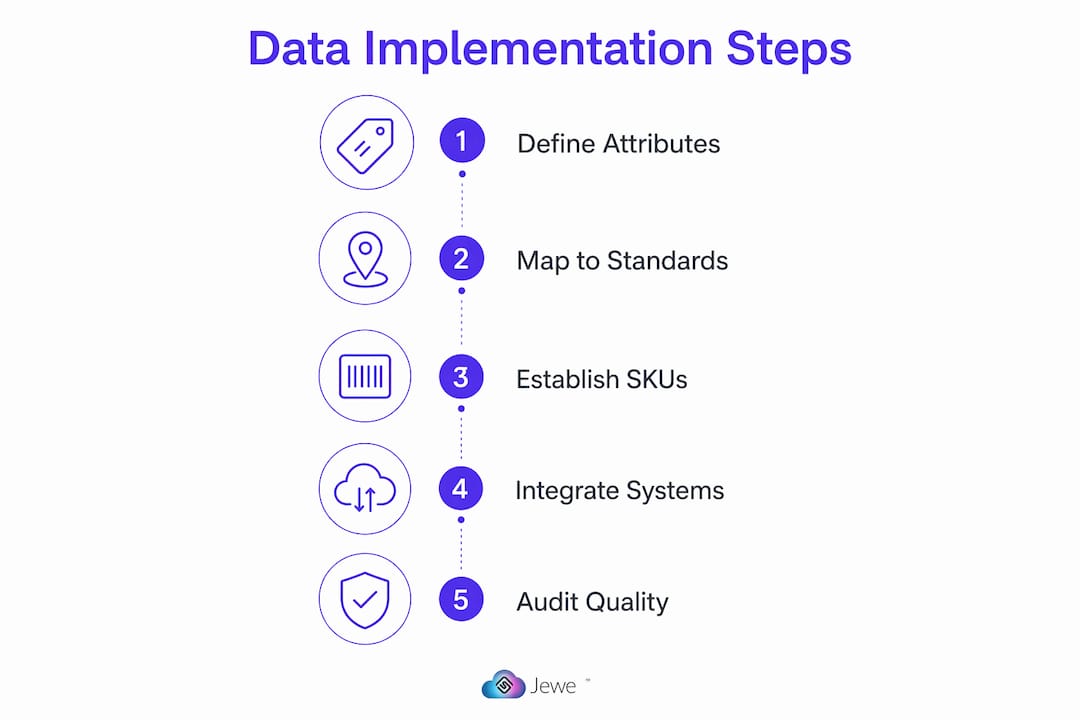
How to implement structured product data for jewelry wholesale
A successful implementation follows a clear sequence. Skipping steps, especially the data audit, is the most common reason projects stall.
- Audit your existing data. Pull every product record you have. Identify missing fields, inconsistent values, and duplicate SKUs. You cannot build a clean system on dirty data.
- Build your attribute dictionary. Define every field, its accepted format, and who owns it. Assign a data steward for each product category.
- Design your taxonomy. Map out your product categories: bridal, fashion, men’s, gemstone, diamond, and so on. Decide how parent and child SKUs relate within each category.
- Create your data templates. Build import templates for each product type. A ring template differs from a pendant template because the required fields differ.
- Load and validate a pilot batch. Start with one category, load 50–100 products, and test every channel connection before scaling.
- Deploy and monitor. Go live, then run weekly validation checks for the first 90 days to catch integration errors early.
Common mistakes that derail implementations:
- Loading products before the attribute dictionary is finalized
- Ignoring Google Merchant Center specifications until after launch
- Treating all jewelry categories as identical when building templates
- Skipping ERP integration and relying on manual inventory updates
- Failing to assign clear data ownership to a specific team member
Pro Tip: Map your attribute fields to Google Merchant specifications before you build your templates. Retrofitting compliance after the fact costs far more time than building it in from the start.
What are common pitfalls in jewelry wholesale product data?
The most damaging problems in jewelry product data share a common root: flat structures applied to a complex product type.
Flat SKU management treats every size and metal variation as a separate, unrelated product. A ring available in sizes 4 through 12 in three metals generates 27 individual records with no shared parent. Search results fragment, inventory counts mislead buyers, and your team spends hours updating the same design attribute 27 times. Parent-child grouping solves this by linking variants to one parent record that holds the shared attributes.
Inconsistent metadata is the second major failure point. Fields like “metal type” entered as free text produce values like “gold,” “Gold,” “14k gold,” and “yellow gold” for the same material. Faceted filters break, search ranking drops, and retail partners reject your feed. Validation rules that enforce a controlled vocabulary at the point of entry prevent this entirely.
Pricing sync failures create the most immediate business damage. Without a live connection to commodity pricing feeds, your gold and diamond prices go stale within hours. That gap erodes margins and damages buyer trust.
“Product catalog automation enforces validation to ensure mandatory jewelry fields are complete before listings go live, reducing returns and mistakes.” — Product Catalog Automation for Jewelry Sellers
Pro Tip: Run a monthly data health audit. Check for missing required fields, duplicate SKUs, and broken image URLs. A 30-minute audit every month prevents the kind of catalog decay that takes weeks to fix.
Why rich product data increases jewelry orders
The business case for investing in product data standardization in jewelry manufacturing and wholesale is direct. Bridal jewelry sales grew 43% year over year at one major retailer after improving product imagery and data management. That result reflects a pattern, not an outlier.
Jewelry pricing is shifting toward transparent, evidence-based models. AI-powered pricing tools use attributes like diamond grade, craftsmanship details, and certification data to justify price differences to buyers. A wholesaler whose data includes those attributes can support that pricing model. One whose data does not get undercut by whoever can show the evidence.
Rich product data also supports your retail partners directly. When you provide complete, structured feeds to your retail accounts, they can launch your products faster, display them more accurately, and sell them with greater confidence. That speed and accuracy strengthens the relationship and increases reorder frequency. Jewelcloud’s product feed for retailers is built on exactly this principle: structured, standardized data that retail partners can use without reformatting.
Key takeaways
Structured product data in jewelry wholesale requires a PIM system, parent-child SKU architecture, DAM-managed assets, and live ERP integration to deliver accurate, channel-ready listings at scale.
| Point | Details |
|---|---|
| Parent-child SKU structure | Group variants under one parent record to prevent catalog fragmentation and inventory errors. |
| PIM and DAM integration | Centralize attributes and assets so one update flows to every channel without manual re-entry. |
| ERP pricing sync | Connect commodity feeds for gold and diamonds to protect margins from manual update delays. |
| Validation rules | Enforce controlled vocabulary at data entry to prevent inconsistent metadata from breaking filters. |
| Rich attributes drive revenue | Complete product data supports evidence-based pricing, stronger SEO, and higher conversion rates. |
What I’ve learned about data infrastructure in jewelry wholesale
Working closely with wholesale jewelers and their retail partners, I’ve seen one pattern repeat itself more than any other: businesses invest in a beautiful website or a new platform, then discover six months later that the real problem was never the front end. It was always the data underneath.
The jewelers who scale without chaos are the ones who treat their product data as a living asset, not a one-time upload. They assign ownership. They run audits. They build validation into the workflow before a product ever reaches a buyer. The ones who struggle treat data entry as an afterthought and spend their time firefighting broken feeds, stale prices, and mismatched inventory counts.
My honest advice: do not wait until you have 5,000 SKUs to build your attribute dictionary. Build it when you have 500. The cost of retrofitting structure onto a large, messy catalog is enormous. The cost of building it right from the beginning is a few days of planning. That investment pays back every time you onboard a new retail partner or launch a new collection without a manual data cleanup project attached to it.
The other thing I would push back on is the idea that ERP integration is an advanced feature for large operations. It is not. Any wholesaler selling products with metal content needs live pricing. The margin risk from manual updates is real and immediate, regardless of catalog size.
— Anthony
How Jewelcloud supports wholesale jewelry product data
Jewelcloud is built specifically for the complexity of jewelry wholesale. The platform gives designers, manufacturers, and diamond dealers a structured environment to load and distribute their catalogs to qualified retail partners, without requiring retailers to carry physical inventory.
Jewelcloud’s product feed delivers standardized, channel-ready data to retail accounts, covering the full range of attributes that jewelry listings require. For vendors, the vendor benefits include automated distribution, increased visibility with retail partners, and a data structure built to handle jewelry’s variant complexity. Retailers gain access to a growing catalog of real wholesale products they can showcase and sell immediately. To see how the platform works for your business, visit Jewelcloud’s B2B platform.
FAQ
What is structured product data in jewelry wholesale?
Structured product data is a standardized set of attributes, including SKU, metal type, gemstone details, certification, and pricing, organized so every product record is complete, consistent, and ready for any sales channel.
Why do jewelry wholesalers need parent-child SKU relationships?
A single jewelry style can have 40 or more size and metal variations. Parent-child relationships group those variants under one record, preventing catalog fragmentation and keeping inventory counts accurate.
How does product data quality affect jewelry sales?
Retailers using complete, consistent product data see measurable sales lifts. One major jeweler reported 43% year-over-year growth in bridal sales after improving product data and imagery management.
What systems do jewelry wholesalers need for product data management?
The core stack includes a PIM for attribute management, a DAM for image and video assets, and an ERP integration for real-time pricing and inventory synchronization.
How does Jewelcloud help with jewelry product data integration?
Jewelcloud provides a structured product feed that distributes standardized jewelry data from vendors to retail partners, covering attributes, images, and pricing in a format retailers can use without reformatting.